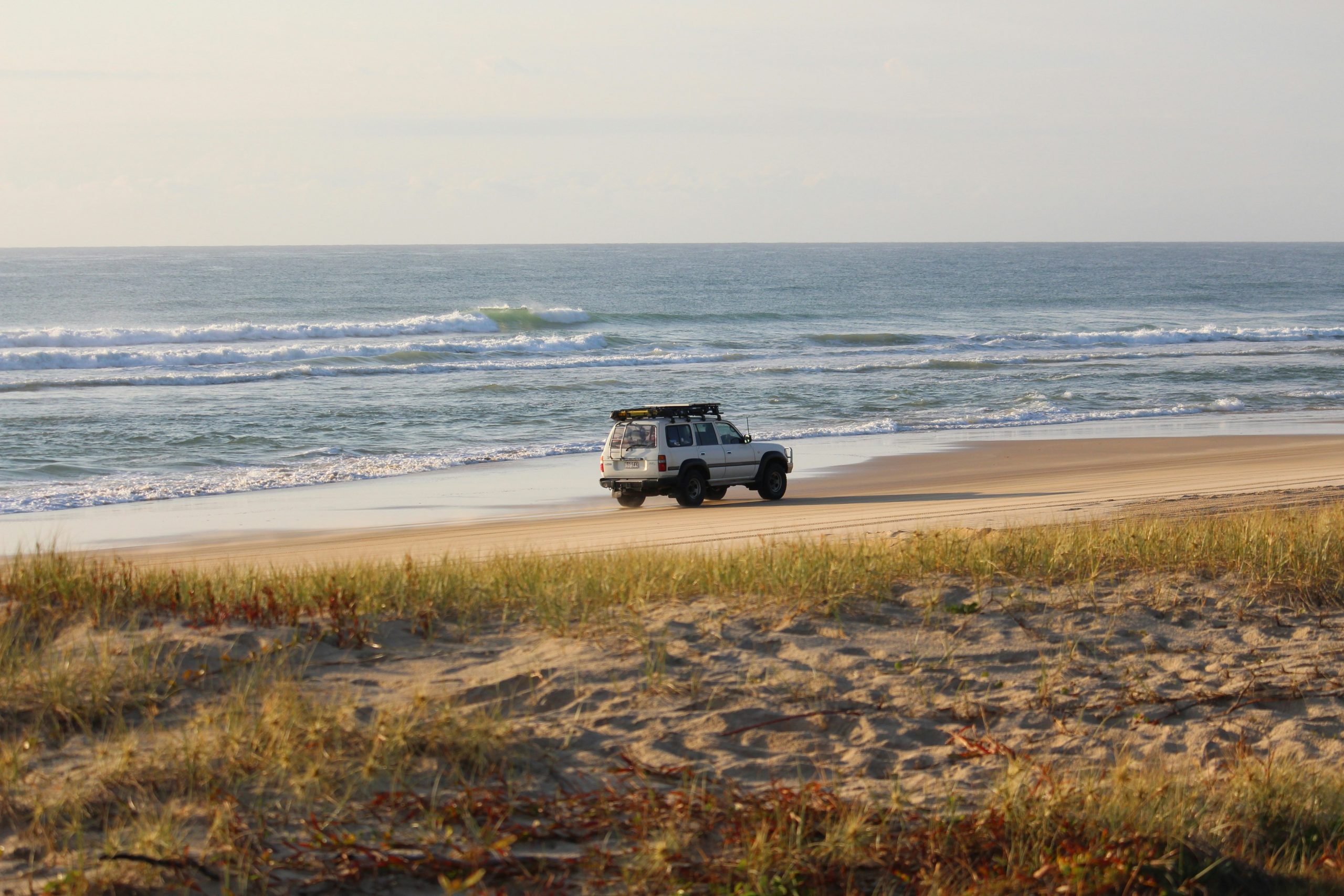
A blue and empty Queensland highway stretching north through sugarcane fields.
Queensland’s east coast road trip is one of those routes that sounds straightforward on paper — just follow the Bruce Highway north — and turns out to be anything but. The 1,400km from Brisbane to Townsville takes you through reef access points, sea turtle nesting beaches, the Whitsundays, and a rum distillery that has been running since 1888. Give it a week and you’ll still feel like you rushed it.
Day 1: Brisbane to Noosa
The first 140km north of Brisbane is the warm-up act. The drive up the Sunshine Coast is easy and the destination earns its reputation. Noosa Heads has a national park that wraps around the northern headland, and the walking track connecting Granite Bay, Hell’s Gates, and Tea Tree Bay is one of the better coastal walks in Queensland — no road access, far fewer people, and views that justify the detour before you’ve even properly started.
If your timing is right, the Eumundi Markets run on Wednesday and Saturday mornings, about 20 minutes inland from Noosa. It’s a proper local market that happens to attract tourists, not the other way around.
Stay the night in Noosa — the Noosa River Holiday Park sits right on the water in Tewantin and is well placed for the national park walks the following morning.
Day 2: Noosa to Bundaberg
This is the day most itineraries gloss over. The drive from Noosa to Bundaberg is about 280km and largely inland — put a good playlist on and get it done. What’s waiting at the other end is worth it.
Bundaberg surprises people. The Bundaberg Rum Distillery has been running since 1888 and the behind-the-scenes tour is genuinely interesting. But the real reason to stop here — if you’re travelling between November and March — is Mon Repos Beach, 15 minutes east of town.
Mon Repos is the largest loggerhead turtle nesting site in the South Pacific. At night, from November onwards, female turtles haul themselves up the sand to lay eggs. From January, the hatchlings emerge and head for the water. It’s one of those experiences that sounds like a tourist attraction and turns out to be something else entirely. Book tickets through Queensland Parks and Wildlife well before you arrive — they sell out fast.
For budget accommodation in Bundaberg, it’s hard to beat a Caravan park stay. They are the best-value base for the turtle experience — Midtown Caravan Park has powered sites from $39/night, cabins, a pool, and is centrally located in the CBD. You can even get a motel there if you are not caravaning.
Day 3: Bundaberg to 1770 & Agnes Water
Only 180km north of Bundaberg, the twin towns of Agnes Water and 1770 are worth the detour off the highway. Agnes Water has the northernmost surf beach in Queensland. The cape called 1770 — named for the year Captain Cook made his second Australian landing here — is essentially a headland and a boat ramp, but the view over Bustard Bay in the late afternoon is one of those simple things that sticks with you.
Day trips to Lady Musgrave Island leave from the marina. It’s a coral cay inside a lagoon, proper snorkelling over hard coral, and one of the less crowded reef experiences on the entire east coast. If you only do one reef day on this trip, do it here.
The 1770 Camping Ground has absolute beach frontage and fills up for good reason. The NRMA Agnes Water Holiday Park sits right on the patrolled main beach if you’d prefer more facilities.
Day 4: 1770 to the Whitsundays
A longer driving day — around 430km — but the Bruce Highway is well-maintained and this is the trade-off for spending proper time in the Whitsundays. Airlie Beach is the mainland base: a compact, lively town with a free lagoon pool on the foreshore and a marina packed with sailing vessels.
Whitehaven Beach, on Whitsunday Island, is the main event. The sand is 98 percent silica — so white it’s almost luminous, so fine it squeaks. Hill Inlet at the northern end produces the swirling turquoise and white pattern that appears on every Queensland postcard. It looks exactly like the photos. That doesn’t happen often enough to take for granted.
Day trips run by boat or seaplane from Airlie Beach. Overnight sailing trips let you cover more islands and are the way most people who have been before choose to do it again.
Day 5: A Full Day in the Whitsundays
Don’t rush this one. One night in the Whitsundays is never enough. Spend the second day either out on the water — another island, another snorkel, a second look at Whitehaven — or simply staying put in Airlie Beach, which has decent food, a relaxed energy, and the kind of weather that makes sitting by a pool feel entirely justified.
If you’re keen to keep moving, the Conway National Park has good walking tracks above the coast with views across the Whitsunday Passage. It’s a quieter alternative to being on a boat and worth an hour or two in the morning before you head north.
Day 6: Whitsundays to Townsville
The final leg is around 370km and takes roughly four hours without stops. Townsville is the largest city in tropical north Queensland and, while it’s not the flashiest destination on the itinerary, it earns its place.
The ferry to Magnetic Island runs every 20 minutes from the city centre and takes 25 minutes. The island has 23 bays and beaches, good walking tracks, and one of the highest concentrations of wild koalas in Australia — not a wildlife park, just eucalypts and koalas going about their business along the Forts Walk. If you have an extra day, stay overnight on the island. Horseshoe Bay after the day-trippers have gone is a different place entirely.
Back on the mainland, the Museum of Underwater Art is worth knowing about — a series of large-scale sculptures installed on the ocean floor, accessible by snorkel or dive. It’s the kind of thing Townsville doesn’t advertise loudly enough.
Rowes Bay Beachfront Holiday Park sits right on the water with views across to Magnetic Island and is the pick for a final night — a good send-off for a drive well done.