
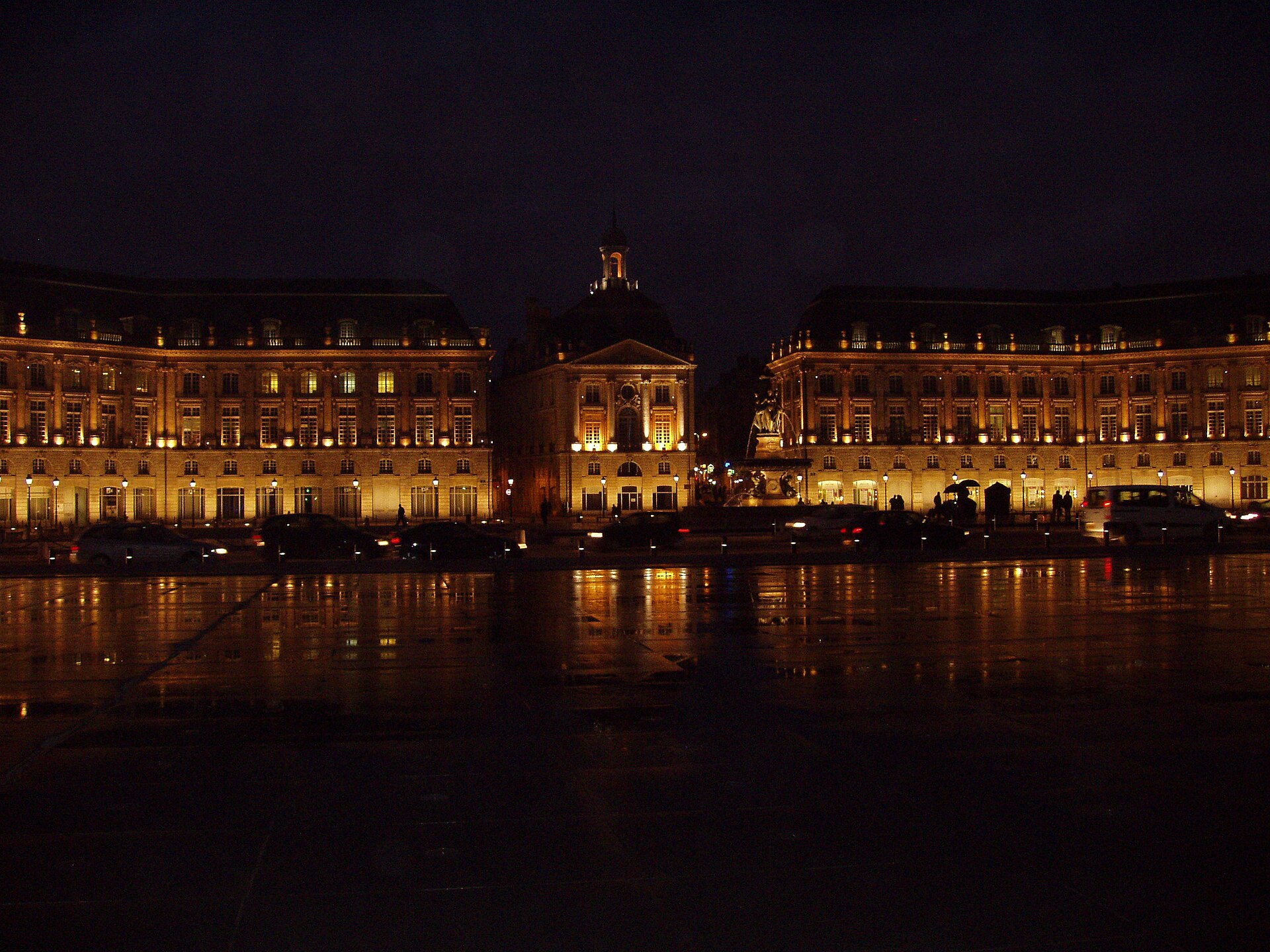
The tram drops you at the river just as the morning light hits the long curve of honey-colored stone that gives Bordeaux its nickname, the Port of the Moon. Ahead, the Miroir d’Eau is throwing a perfect reflection of the Place de la Bourse into a thin sheet of water, and a handful of early walkers are already drifting across it with their shoes in their hands. Behind you, a bakery has just opened its doors, and the smell of cannelés caramelizing is making it very hard to go anywhere else.
That’s the thing about Bordeaux. It’s a city that rewards walking the way few others do: compact, flat, built on a human scale, and layered with two thousand years of history that sits right at street level. You don’t need a car, a bus tour, or a plan. You need comfortable shoes, a loose morning, and a willingness to be pulled down side streets. Here’s how to walk through Bordeaux and come away understanding its culture, its past, and the way people actually live there.
A City Preserved on a Grand Scale
Bordeaux’s walkability is partly an accident of history and partly a deliberate act of care. According to UNESCO, the Port of the Moon was inscribed on the World Heritage List in 2007 as an outstanding urban and architectural ensemble of the Enlightenment, covering 1,731 hectares and including 347 individually protected buildings.
That’s one of the largest urban World Heritage areas anywhere, and nearly all of it can be covered on foot. The unified classical and neoclassical facades that make the city feel so coherent are the backdrop to every walk.
Start With the Stone
The 18th century is Bordeaux’s defining era, when wine wealth rebuilt the city in the pale limestone that still dominates it. A walk through this period runs naturally:
Place de la Bourse and the Miroir d’Eau on the river, the postcard view
The Grand Théâtre, with its row of columns and statues
Place des Quinconces, one of the largest squares in Europe, with its monument to the Girondins
Cours de l’Intendance and the elegant streets of the Golden Triangle
Look up as you go. The carved faces above doorways, called mascarons, are everywhere, and each one was a statement of its owner’s taste and ambition.
The Older Bordeaux Behind the Squares
Bordeaux didn’t begin with wine merchants. Walk a few minutes from the grand squares, and the city’s older layers appear:
Palais Gallien, the ruins of a Roman amphitheater tucked into a residential street
Cathédrale Saint-André, where a young Eleanor of Aquitaine was married
Porte Cailhau and the Grosse Cloche, medieval gates that survived the city’s rebuilding
The Saint-Pierre district, a tangle of narrow streets where the medieval port once stood
Each of these sits within a short walk of the next, which is what makes the city’s history feel continuous rather than museum-like.
Let a Local Connect the Dots
Walking alone is a pleasure; walking with someone who knows the stories is a different experience entirely. A guided walk strings the squares, gates, and side streets into a narrative, explains why a particular facade looks the way it does, and points out the bakery, the bar, and the market a visitor would otherwise walk past.
Among the options in the city, Bordeaux Free Walking Tours runs a two-hour route through the historic center every morning, covering the cathedral, the Place de la Bourse, the Grand Théâtre, the Miroir d’Eau, the medieval gates, and the Saint-Pierre quarter, with local food and drink tips along the way.
Guides meet guests under a purple umbrella outside the cathedral, groups are kept small, and the tour works on a pay-what-you-wish basis, so visitors decide at the end what the walk was worth. It’s a good way to orient yourself on the first morning and build the rest of the stay around what you’ve seen.
Find the Daily Rhythm
Culture in Bordeaux is as much about routine as monuments. To see how the city lives:
Visit Marché des Capucins in the morning, where locals buy oysters, cheese, and produce and eat them standing at the counters
Walk Rue Sainte-Catherine, the long pedestrian shopping street, and then duck off it into the quieter lanes on either side
Take a mid-afternoon coffee at a terrace and watch the city slow down
Cross the Pont de Pierre at dusk to see the whole riverfront light up
Wander Chartrons, the old wine-merchant quarter turned antique and café neighborhood
None of these are attractions in the ticketed sense. They’re where Bordeaux happens.
What to Eat and Drink in Bordeaux
Walking builds an appetite, and the city makes it easy to satisfy. Look for:
Cannelés, the small caramelized pastries that are Bordeaux’s signature
Oysters from Arcachon, served at market counters with a glass of white
Entrecôte à la bordelaise, steak in a red-wine and shallot sauce
A glass of the local wine at a bar à vin, where staff are happy to explain what you’re drinking
Many wine bars pour by the glass from producers across the region, which turns a simple drink into a short education.
Walk the Riverfront
The quays along the Garonne were once working docks and are now a long promenade of gardens, skate parks, and open space. Walking the curve from the Place de la Bourse toward the Cité du Vin, the modern wine museum shaped like a swirl in a glass, shows how the city has turned its river from a barrier into its front garden. It’s also the best place to understand why the port shaped everything else.
Practical Notes for Walkers
Exploring Bordeaux on foot is one of the best ways to experience its historic charm, but a few practical tips can make your walking adventure smoother and more enjoyable.
Bordeaux is flat and compact; most sights are within 30 minutes of each other on foot
Trams fill the gaps if feet give out
Cobbles in the old town call for sturdy shoes
Shops close for lunch in some quarters, and Sundays are quiet
Carry a little cash for markets and for tipping guides
With comfortable shoes, a little planning, and these simple tips in mind, you’ll be ready to discover Bordeaux’s beautiful streets, hidden corners, and local culture at your own pace.
Conclusion
Walking through Bordeaux is the best way to discover French culture, history, and local life because the city puts all three within reach of a single pair of shoes: the Enlightenment grandeur of the riverfront squares, the Roman and medieval layers hiding a few streets behind, the markets and terraces where the daily rhythm plays out, and the wine and food that tie it all to the countryside beyond.
With more than seventeen hundred hectares protected as World Heritage and nearly every corner of it walkable, there’s no better plan than a loose one. Start at the river, follow the smell of the cannelés, and let the city show you the rest.