I was thirty-four when I first put on ski boots, standing at the bottom of an Austrian nursery slope holding my poles like a man carrying two umbrellas he did not want. Around me were six-year-olds in animal-shaped helmets, falling over constantly and getting up as if falling were simply part of the activity, which it is. It took me four days to stop treating a gradient of ten degrees as a personal threat, and two seasons to understand that where I had chosen to learn mattered far more than I had assumed when I booked it.
What Nobody Tells You About Learning at Thirty-Five
The physical part was not the problem. The problem was that I had a functioning adult’s sense of embarrassment and a clear mental image of how I looked. Children learn partly because they do not care. I cared enormously, and that made me stiff, and stiff is the worst thing you can be on skis.
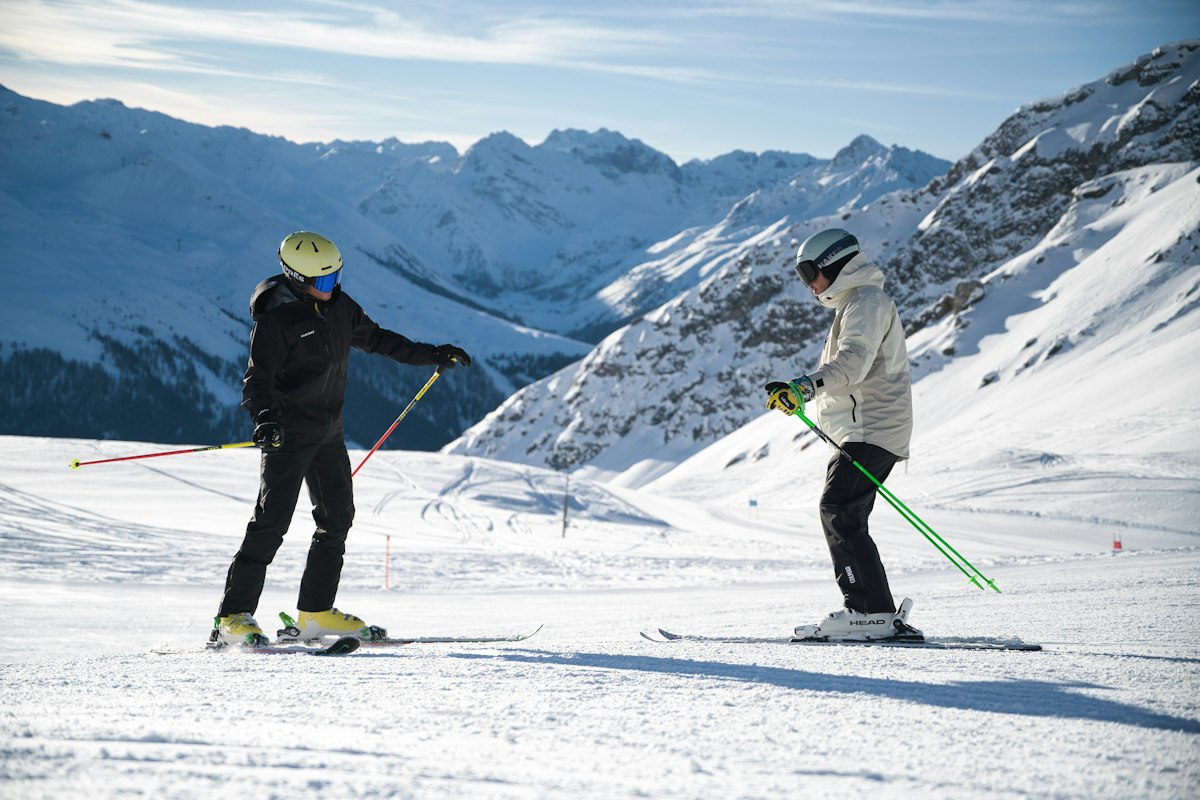
What fixed it was not willpower. It was being put in a group of five other adults who were all equally bad. One was a woman in her fifties whose husband had skied for forty years and had finally stopped offering to teach her. By the second morning we were faintly competitive about a drag lift, and by the fourth we were doing something an onlooker might have mistaken for skiing. A resort’s adult beginner provision is not a detail. Where a ski school really only runs children’s classes and private tuition, you end up alone with an instructor who is very good and very patient, paying a lot, and learning less than you would among peers.
What Actually Makes a Resort Good for a Beginner
After a few seasons of paying attention, I would judge a resort on four things, in this order:
- The depth of the ski school. Not whether one exists, but whether it runs adult beginner groups every week of the season, in a language you speak, with enough instructors to sort people by ability rather than throw them together.
- The length and pitch of the easy runs. A beginner needs long, wide, consistent gradients. A short blue that steepens unexpectedly in the middle is worse than useless, because what you need to build is the habit of linking turns for minutes at a time without panicking.
- Somewhere to go after the nursery slope. A resort can have a superb beginner area and nothing above it, so the reward for your first good week is being stuck. You want an easy route that goes somewhere, ideally a way back to the village on snow.
- The scale of the base. A village where everything is a five-minute walk is a kinder place to be tired and demoralised than one needing a bus at both ends of the day.
The Arlberg, Where the Ski School Was Invented
I did not expect to recommend the Arlberg to beginners, because its reputation is built on steep terrain and deep snow. But the history is not decoration. Hannes Schneider was born in Stuben in 1890, and in 1921 he founded the ski school in St Anton that effectively set the template for every ski school since: pupils sorted by ability, a fixed sequence of exercises, instructors trained to teach rather than simply to ski. His Arlberg technique — a stem into the fall line, then a parallel turn across the hill — was the first widely taught method of getting an ordinary person down a mountain, and it travelled from these villages to Japan and New Hampshire. The Ski Club Arlberg had been founded two decades earlier, in 1901, at the Hospiz in St Christoph.
That tradition is still physically present. St Christoph, at around 1,793 metres, is where the Austrian federation’s academy trains and certifies instructors, a strange and reassuring thing to ski past on your third day. The teaching culture here is unusually serious, and it filters down to beginner groups.
The terrain is also kinder than the reputation suggests. The Arlberg counts roughly 130 kilometres of easy slopes, a little over forty per cent of its blue-graded total: valley conveyor belts at St Anton, St Christoph and Stuben, a beginner area at the Gampen station, and wide, forgiving pitches between Galzig and Kapall that go on long enough to learn something. Which village a beginner sleeps in matters more here than in most places. Ski Arlberg runs as one linked area on a single pass, but the transfer in from Innsbruck or Zurich, the walk to the nearest lift and the amount of easy ground within reach on a bad-weather day are all different propositions in St Anton, St Christoph and Stuben.
Stuben and St Christoph are the gentler bases. Stuben is the smallest of the five Arlberg villages — about ninety permanent residents, some nine hundred guest beds — and quiet in a way St Anton is not. Be honest about one thing, though: the terrain directly above Stuben, up at Albona, is not beginner ground. Your easy skiing happens around Rauz and over towards St Christoph. Use Stuben for the calm, not the slope outside the door.
Two Quieter Alternatives I Would Genuinely Consider
The Arlberg is expensive, and I will not pretend otherwise. Two places gave me more progress per euro.
The Hochkönig region in Salzburgerland — Maria Alm, Dienten and Mühlbach — has about 52 kilometres of easy slopes and a signed circuit, the Königstour, that loops the region across roughly 32 kilometres and some 6,700 metres of cumulative descent on mostly blue and red runs, the black sections avoidable. It is not a beginner’s first week. It is the thing to aim at in your second, and it answers the question of where you go once the nursery slope is behind you.
In Italy, Passo Tonale is where I would send a nervous adult. The beginner terrain at Valbiolo is wide and open and the pass costs a fraction of its Austrian equivalent. There is less easy mileage than at Hochkönig, roughly 24 kilometres, and the lower slopes at Ponte di Legno and Temù are not beginner ground. Alta Badia is the other Italian answer: around 74 kilometres of easy runs, more than half its blue total, beginner areas in Corvara and La Villa, six ski schools. Dearer than Tonale, but the gentlest long cruising I have skied.
| Area | Easy slopes | Adult day pass, 2026/27 | Six days |
|---|---|---|---|
| Arlberg | about 130 km | around €85 | around €470 |
| Hochkönig | about 52 km | around €80 | around €430 |
| Passo Tonale | about 24 km | roughly €52–70 | roughly €160–345 |
Lessons are the other cost. A four-hour adult beginner group day at an Arlberg school was listed at roughly €90 to €130 per person for the coming season, and such courses often need a handful of people to run at all — one more reason to travel in a school week rather than a quiet fortnight.
What I’d Tell a Beginner Now
Book six days, not three. The fourth day is when it stops being an ordeal and starts being a sport, and if you have gone home by then you will remember only the ordeal. Book a group rather than a private lesson, at least to begin with, because the other adults in it are the reason you keep going. Choose somewhere with long, dull, gentle runs over somewhere famous, and come back to the famous place in your third season, when you can enjoy it. And pick a small village if you can. My week in Stuben, four minutes from the lift in ski boots, did more for my confidence than anything an instructor told me.