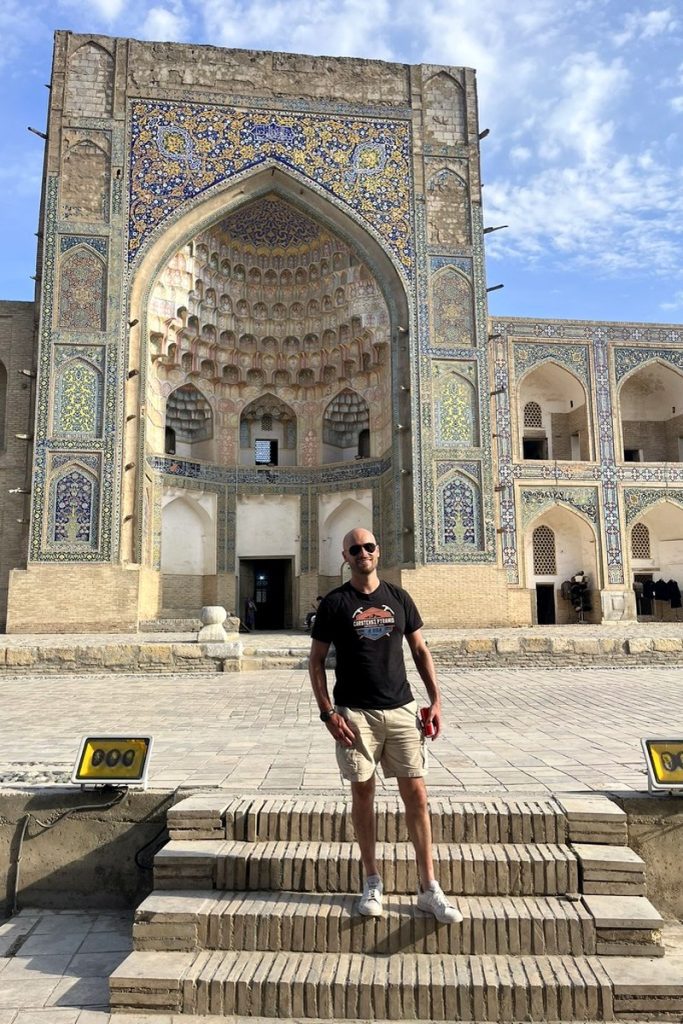
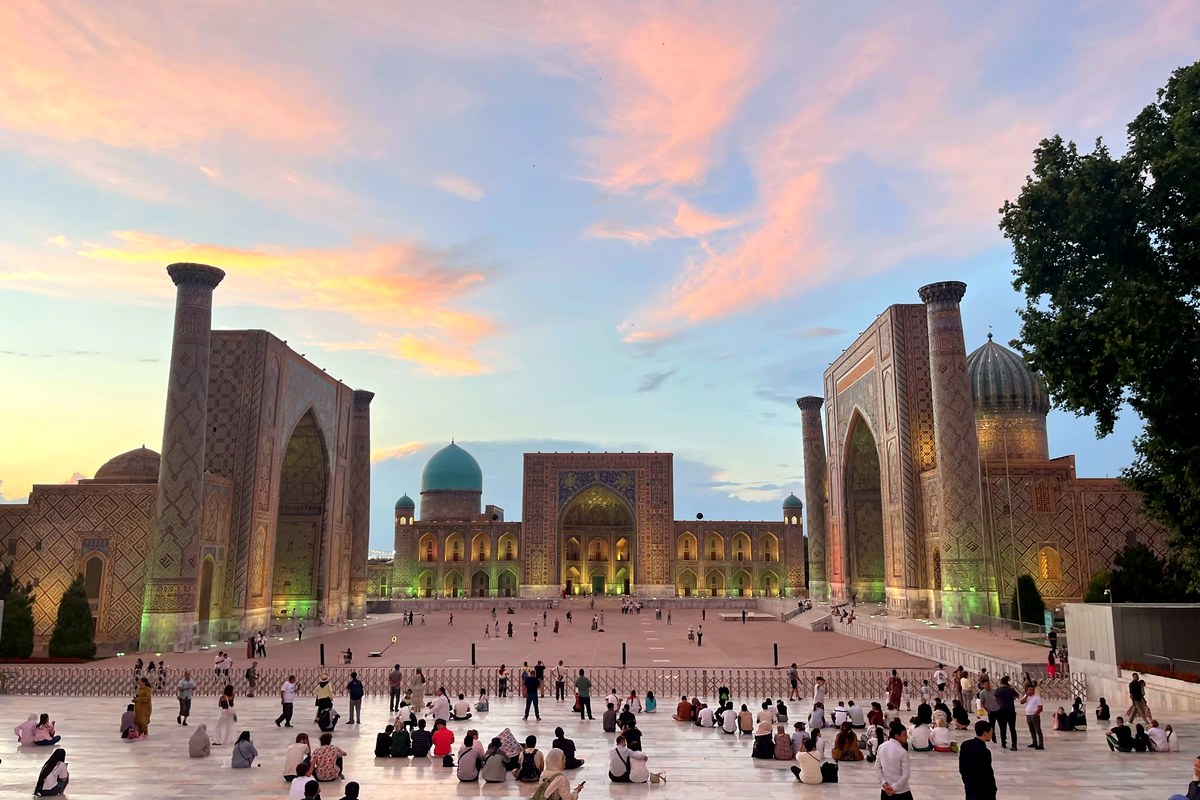
My Uzbekistan trip gifted me with a sunset hall-of-fame entry after 15 years of travel. During an intense group trip with a lot of strong personalities, we watched the brutal Central Asian summer sun go to sleep at dusk over the spectacular historic public square, Registan, in Samarkand.
Check out the pink skies contrasting with the blue, green and white artwork. Incredible.
Uzbekistan is one of the Stans’ most established tourist destinations, with people opting to visit over its neighbours Kazakhstan and Kyrgyzstan due to its flight accessibility and strong infrastructure, but don’t mistake “more common” for dull and predictable; this country hosts some gems in its very large locker and, in my opinion, one in the Stans that ticks the “would go back again” box.
From bullet trains to turquoise-domed mosques and magical markets, there’s plenty to do in Uzbekistan, and architecture lovers are in for a big treat; here’s the best of the country after my 5-day group tour with Mudita.
1. Ride the Afrosiyob bullet train
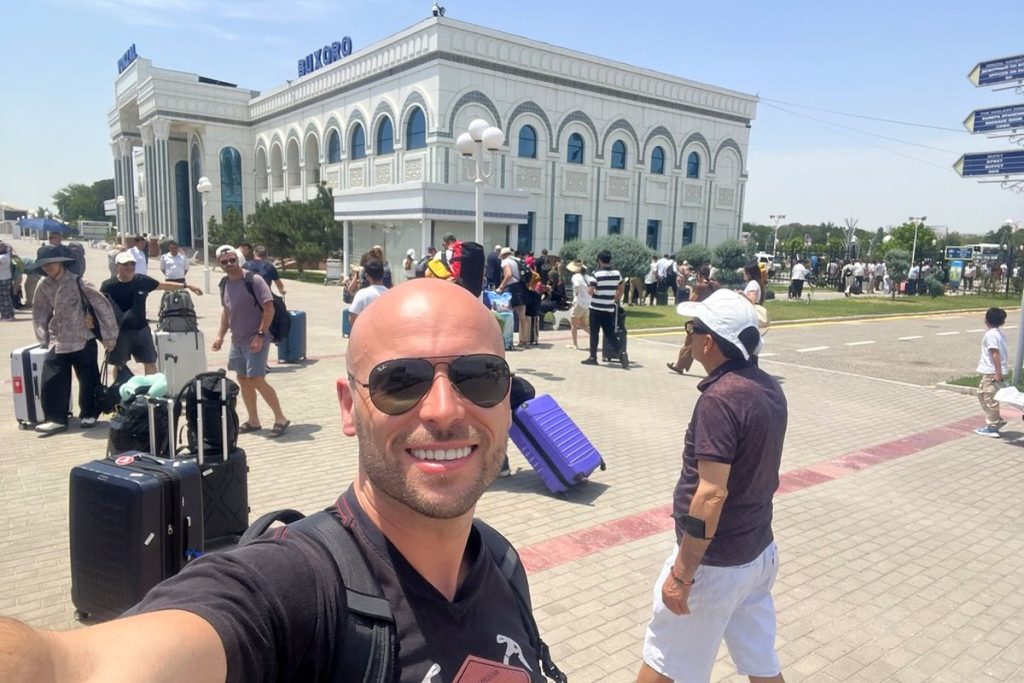
The Afrosiyob bullet train connects major Silk Road cities such as Tashkent, Samarkand and Bukhara at a lightning speed of 250 km/h (155 mph) with comfort and convenience. Fun fact: the trains (built by Spaniards) are named after Afrasiyab, an ancient city under Samarkand which was destroyed by the Mongols in 1220 AD.
The original name comes from the mythical king Afrasiab in Persian legend, translating to “beyond the black river.”
It’s at this point where I have to be miserably British and bemoan how inferior ours are compared to most of the world, even though we invented them.
Our tour took the train from Kagan (the station serving Bukhara) to Tashkent on a smooth 4-hour journey. Ideal for a hangover snooze on a very boozy trip. Views outside the window are flat and arid: dry plains with a glimpse of farmland and village life. It’s a flirtation of train travel observations compared to slow sightseeing, but in a country this big, I was thankful for the speed.
2. See the brand-new Islamic Civilization Center, Tashkent
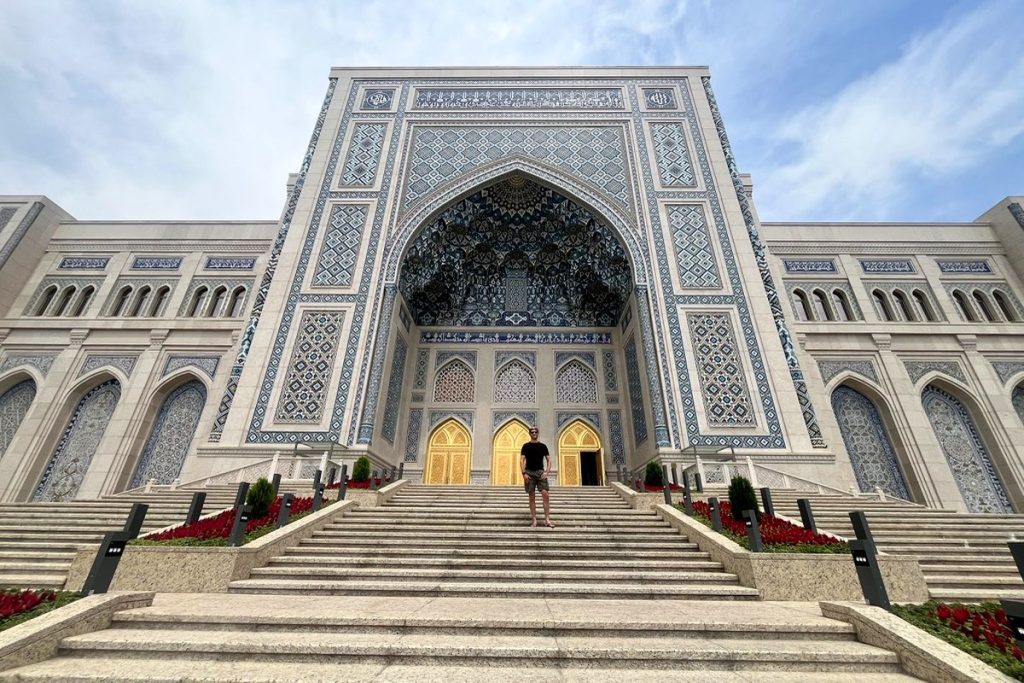
This big, beautiful beast in Tashkent is the world’s largest museum of Islamic civilisation, taking eight years to build, and it only opened in March 2026, spearheaded by the president’s goal to showcase Islam’s contributions to philosophy, maths and society while celebrating the country’s proud muslim roots.
Understandably, the building looks like a giant mosque, with atypical blue and turquoise tiles adorning it. It’s also worth pointing out that it follows Islamic rules in terms of dress code, so treat it like a place of worship and hide away those gorgeous Tina Turner pins of yours.
This place is massive, and the Guinness Book of Records confirms it, so plan accordingly and allow more time if you want to make an occasion of it. The highlight of the Center is the Qur’an Hall, which has a hologram of Tashkent’s night sky shining proudly over the dome.
3. Get a head shave and beard chop in Tashkent
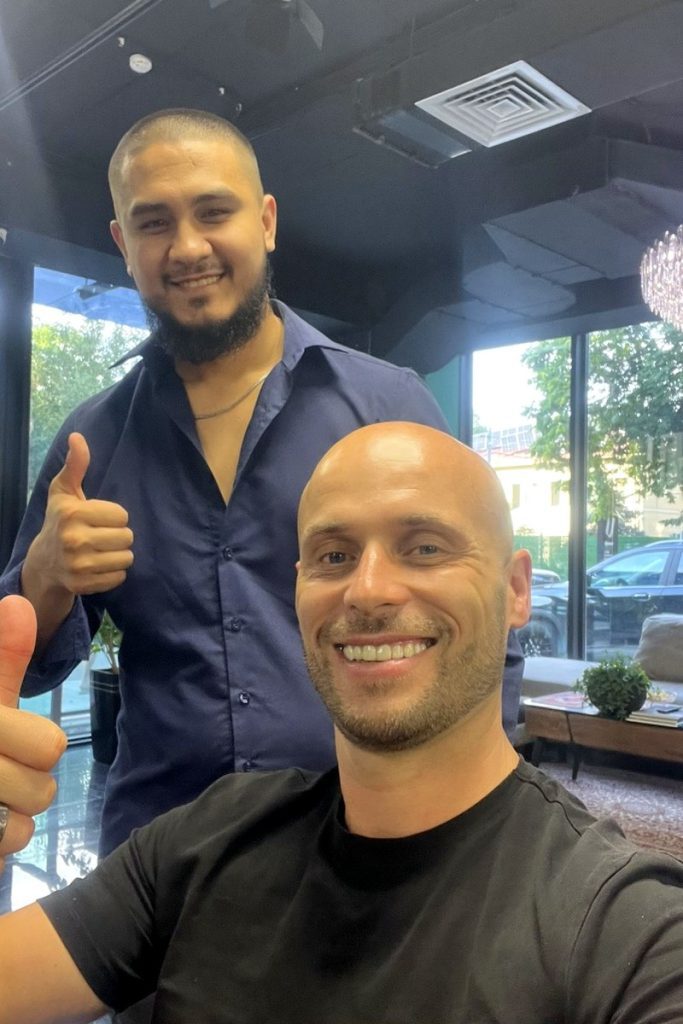
Contrary to the annoying popular belief, being bald does not mean barber-free. In fact, if you throw in beard care and a man with higher standards/neurosis than normal, then it becomes quite the chore when travelling.
However, Central Asia, Turkey and the Middle East are the literal mecca for a haircut/head shave, and if you have a beard you’re in good hands in this region. The full works: just enough charming small talk, a hot towel, and moisturiser to leave you feeling years younger than the dishevelled mess that sauntered in.
4. Experience the Registan at golden hour, Samarkand
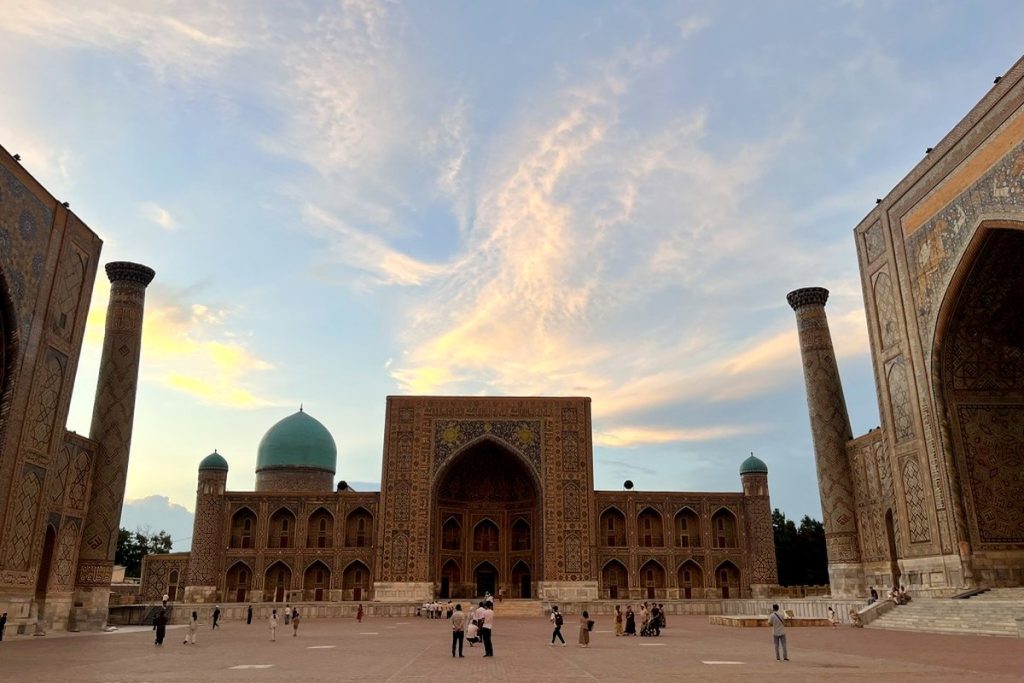
Visiting the Registan is the best thing to do in Uzbekistan, in my honest opinion. I started this blog piece tipping my hat to the sunset, which adds to the building’s beauty, and I can’t hammer this home enough: plan your visit to the Registan so you have enough time to finish and wander around at sunset, when the light turns the brick pink, and the domes take on a whole new beauty.
Also, if you’re a fashionista (which I certainly am not), wear blue for the photos. I saw a lot of local women doing it; they looked awesome.
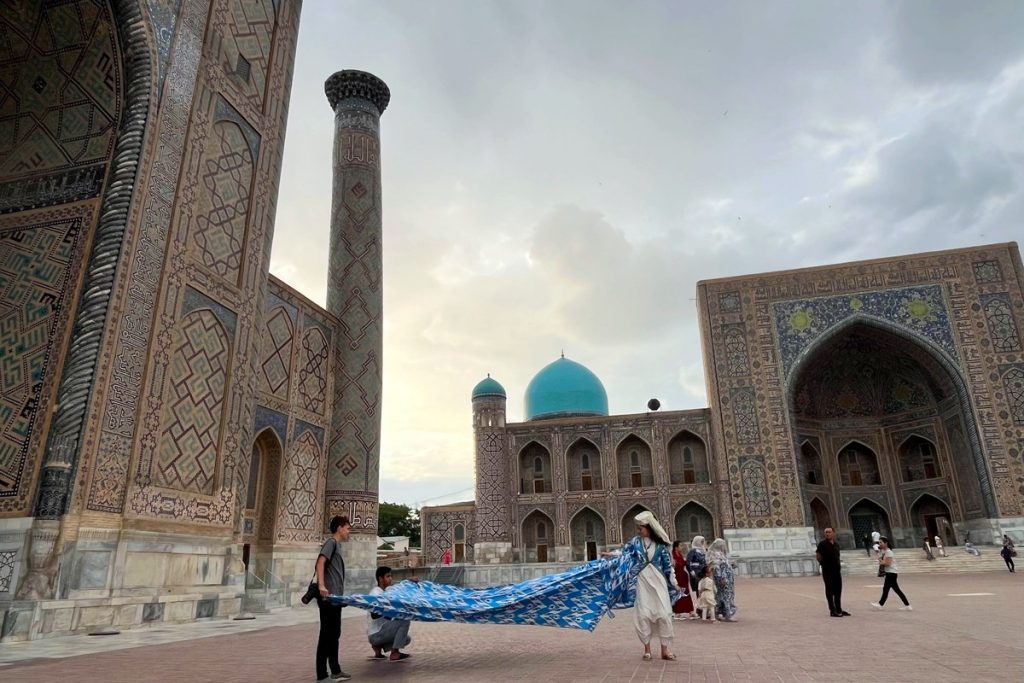
About that… I’ve mentioned many times in this article the blue-and-white contrasts all around Uzbekistan’s theatrical architecture. Blue is my favourite colour, and this shade is my favourite shade of blue. It also reminded me of the mosques when I visited the country’s neighbours, Afghanistan, so I was naturally curious whether there was any connection, or what the reason was for Uzbekistan’s obsession with this colour format.
The main theory is that, in Timurid tradition, blue symbolised the heavens and spirituality in Islamic design, and white usually symbolised purity. Another theory is that the Turkic and Mongols, who predate the Timurid Empire itself, revered Tengri, the sky God.
The three madrasas that face one square support both claims:
- Ulugbek (1417–1420, built by Timur’s astronomer grandson)
- Sher-Dor (1619–1636)
- Tilya-Kori (1646–1660,)
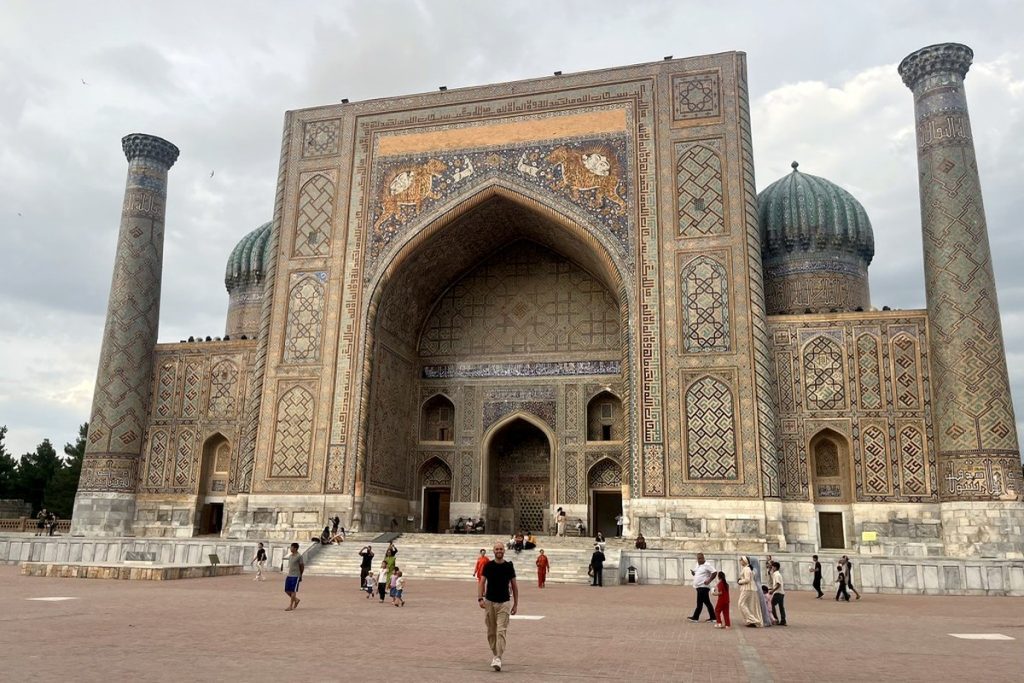
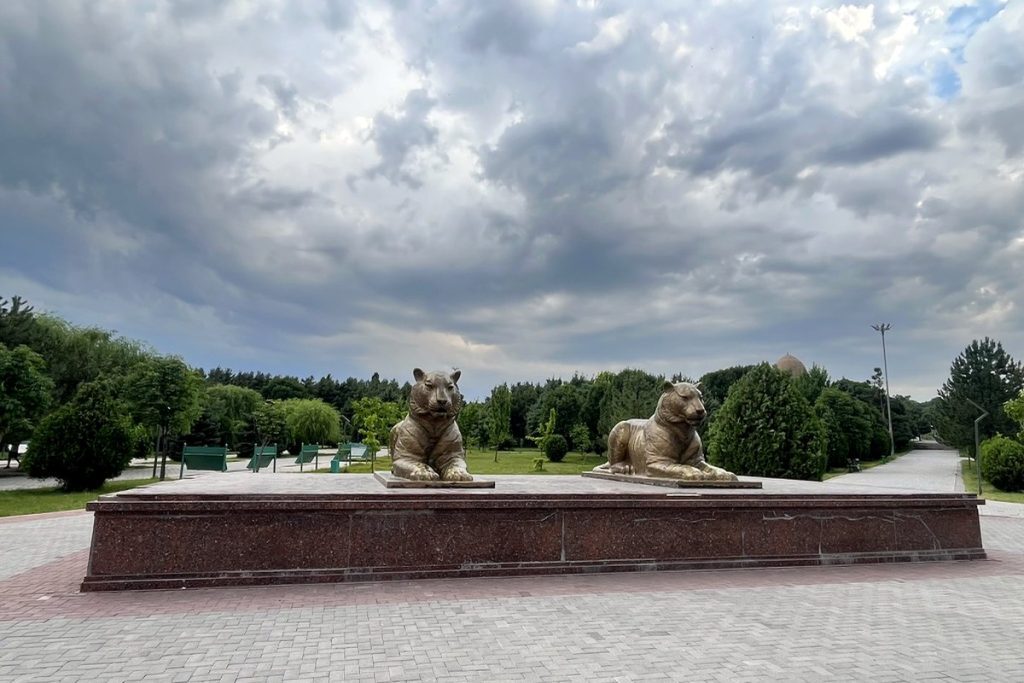
I guess we will never know why, but I think it’s cool that six centuries of architecture still remains, with a heavy lick of paint, of course.
It is 100,000 UZS to enter the Registan, and if you want seats for the evening light show, it is 150,000 UZS; I recommend a chilled-paced three-hour visit. Unfortunately, the light show was cancelled, but I couldn’t complain. This place was the highlight of my Uzbekistan visit.
5. Pose with the Samarkand sign
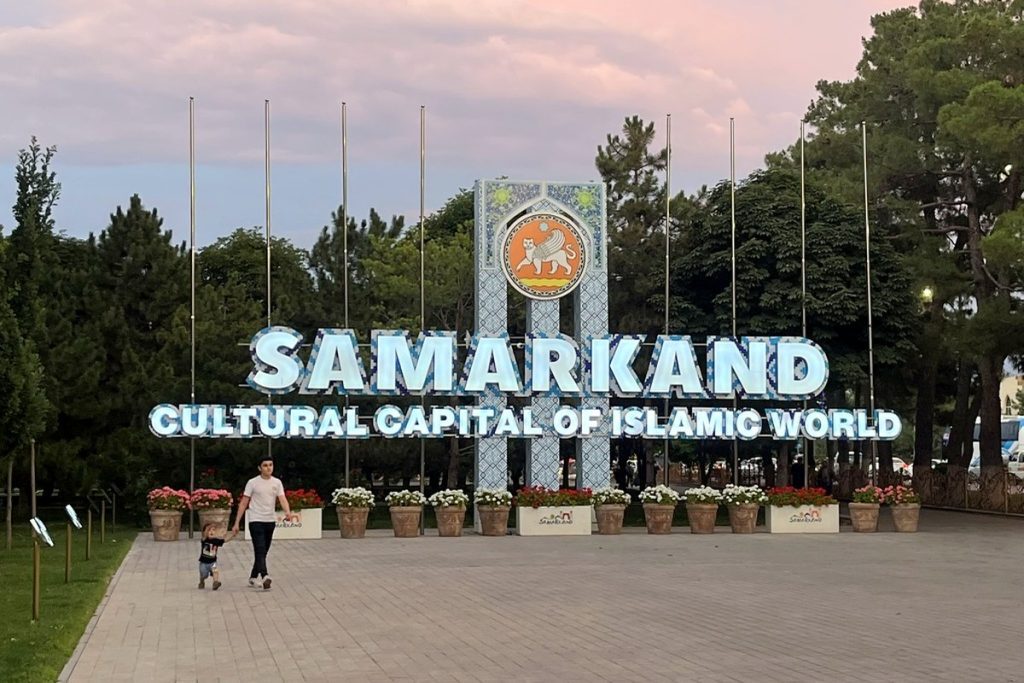
Why take yet another photo of large letters spelling out the name of the place you’re in? Why not, I say.
It’s a little cheesy, but it’s also a free souvenir. This city is 2,800 years old and has one of the most spectacular buildings you may feast your eyes on. It’s also convenient if you’re in the city centre; no detour is needed when you’re wandering en route or heading back from a bite to eat.
6. Visit Timur’s “cursed” tomb, Gur-e-Amir (about 220)
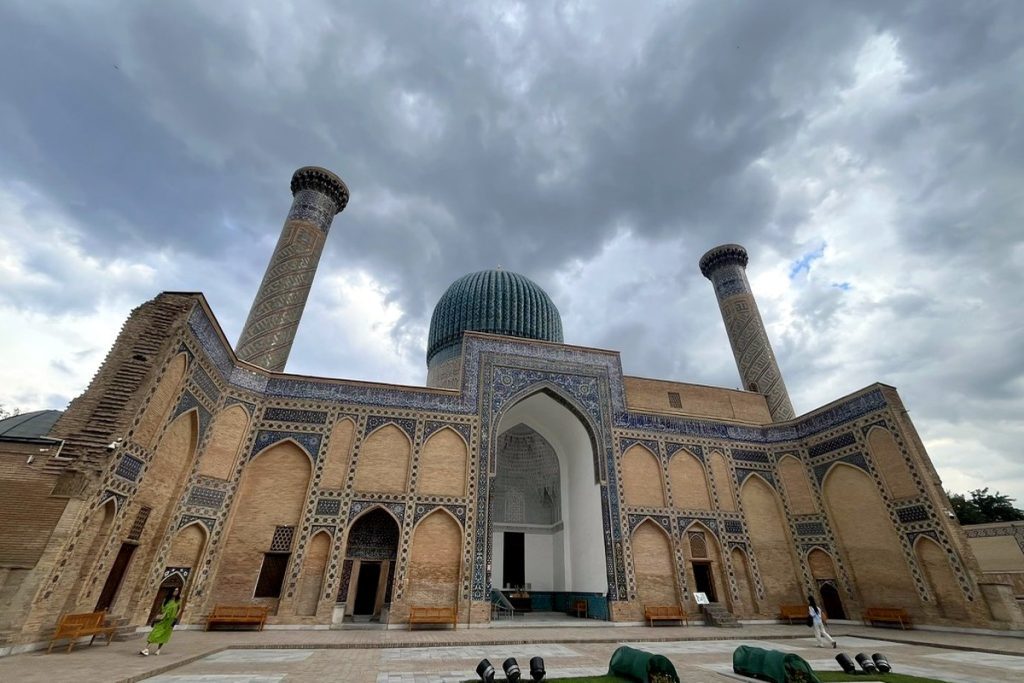
If you’re not quite done with pretty blue and white buildings, then fifteen minutes’ walk away from the mighty Registan is another one with a fascinating story behind it called “The Curse of Timur.”
Amir Timur is the man buried inside the tomb, the warrior who founded the Timurid Empire, which spread across modern-day Afghanistan, Iran, and Central Asia. He died in 1405 during a harsh winter march that left him ill on his way to China.
As he died, he gave rise to a folklore that lives on in modern-day Uzbekistan: if his tomb were to be disturbed, the person or people doing so would meet a catastrophic fate. A fanboy named Nader Shah stole a jade slab from the tomb in 1740, and his son became very unwell after a series of bad luck until he returned the stone.
Most recently, Soviet anthropologists dared to open the tomb in June 1941; linguists confirmed an inscription with a strict warning to those who dared to open it. On June 22nd, 1941, Nazi Germany unleashed Operation Barbarossa, which was a major turning point in World War II.
Some superstitious Uzbeks believe the main reason the Soviets won the famous Battle of Stalingrad was that they did the right thing and reburied Timur a month before the victory. A karmic gesture from the universe, or perhaps Timur’s wrath from beyond the grave.
Tickets cost 75,000 UZS; the small journey from the Registan is worth it for the story alone. Leaving mystery for a cool fact: This mausoleum influenced Mughal tombs in India; one of them was called the Taj Mahal (you might have heard of that one!)
7. Stand under the Bibi-Khanym Mosque
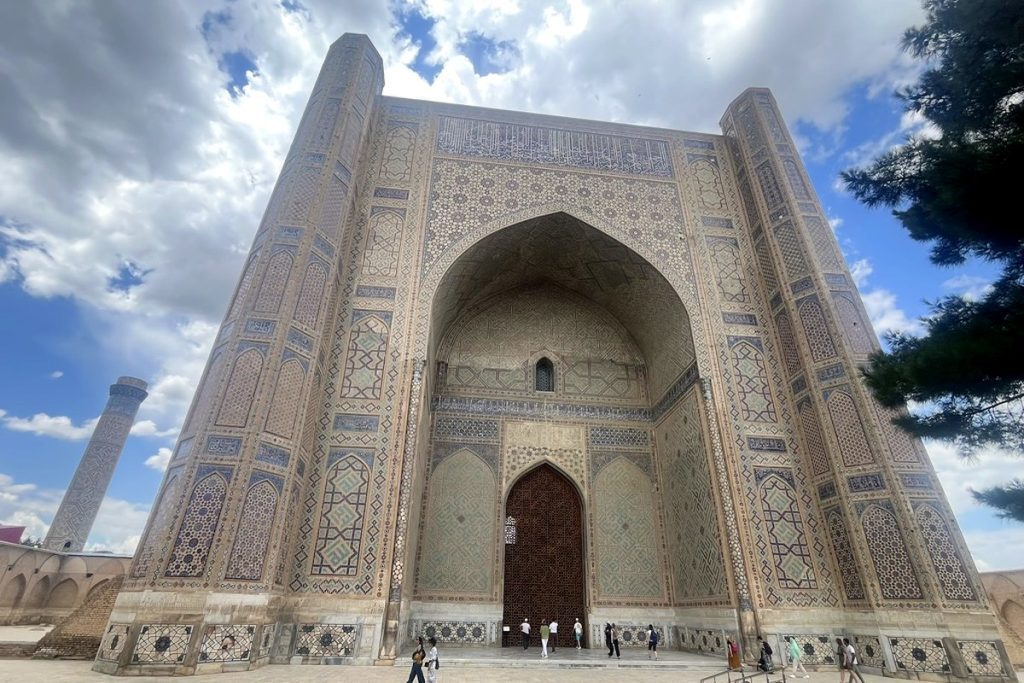
Seen one gorgeous blue and white building, seen them all, right?
Blastheme!
Philistine!
After the main man Timur ended his military campaign in India, this was intended to be one of the grandest mosques in the world. However, a massive earthquake in 1897 destroyed most of it. Yet with a few coats of paint, it stands tall, with a folklore scandal hanging over it.
You see, the mosque was named after Timur’s wife, who commissioned the mosque as a “welcome home, honey” gift after returning from battle. Art clashed with the heart’s desire, and the architect, smitten with her, refused to finish the building until he had stolen a kiss.
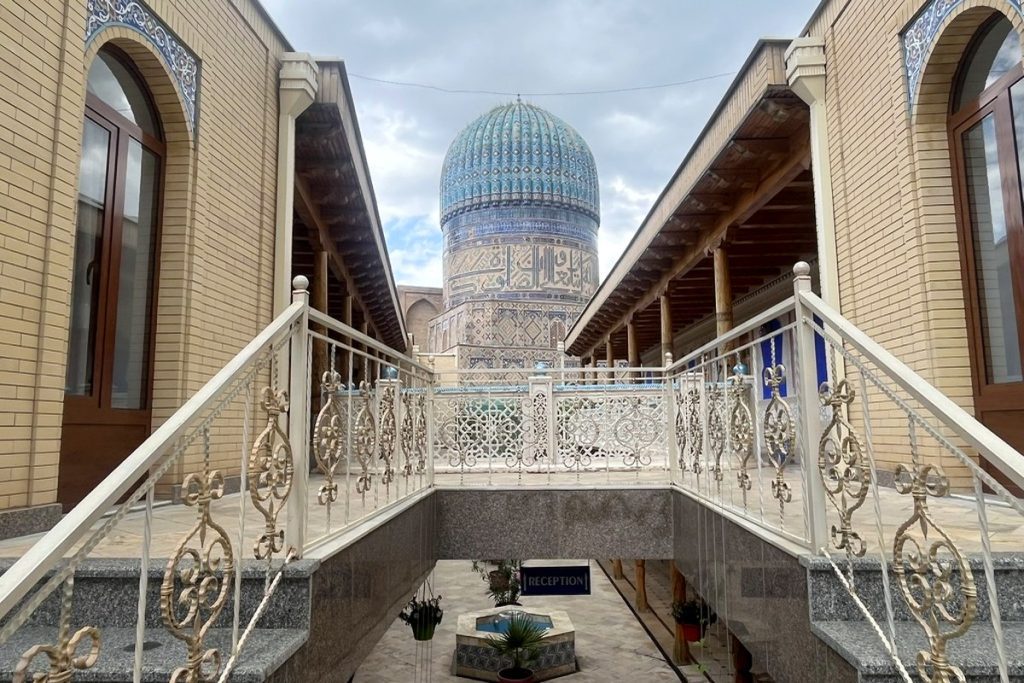
Apparently, he got a cheeky peck on the cheek, which Timur discovered when he returned. There are several versions of what happened next, none particularly romantic for the architect!
8. Walk the Shah-i-Zinda necropolis
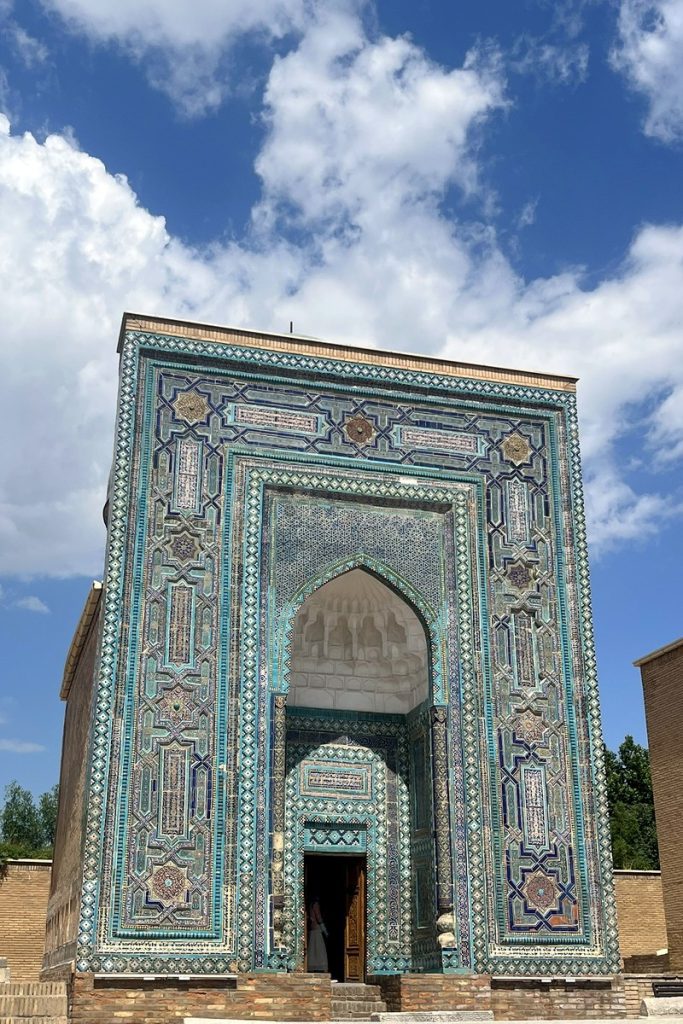
While Registan will wow you with its beauty and sheer scale, the Shah-i-Zinda (translated as “The Living King”) seems more intricate and moving up close and arguably Samarkand’s most mesmerising building to visit.
The Necropolis is attributed to Prophet Mohammad’s cousin, believed to have travelled to Samarkand in the seventh century. Unique things to look out for:
- The headless preacher: Legend has it Mohammad’s cousin was beheaded while praying (one of many theories surrounding how he died).
- Timur’s female relatives: Among the mausoleums are Timur’s sister and niece.
- The staircase superstition: There are 36 steps leading towards the main avenue. According to local folklore, if you count the same number ascending and descending, your sins will be forgiven.
9. Climb up for sunset over the Kalyan Minaret, Bukhara
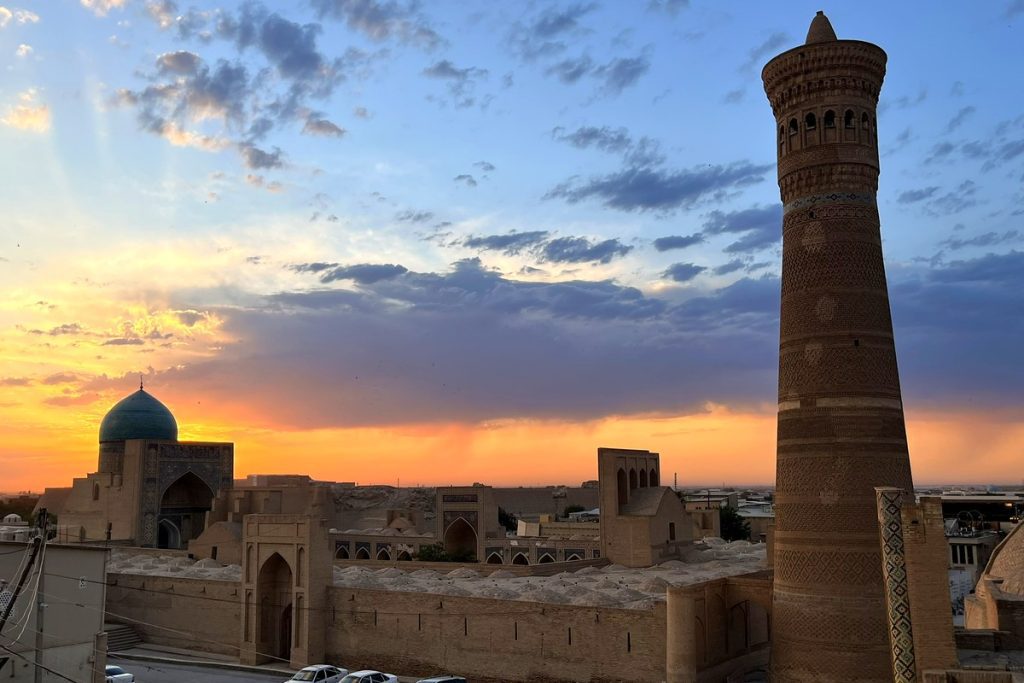
Coming away from my blue obsession, Bukhara as a city has a more earthy, sandy backdrop, and the Kalyan Minaret at sunset is the main reason to visit.
Not many buildings (or people) can say they were face-to-face with Genghis Khan and lived to tell the tale, yet the Kalyan Minaret holds those bragging rights. According to legend, Genghis stormed Bukhara in 1220, tipped his hat to look at this striking tower, and his hat fell off.
After dismounting his trusty horse, he was said to bow to the beauty and proclaim it untouchable as he pillaged the rest of the town. The minaret is also known as “The Tower of Death,” as condemned prisoners were taken up for a lovely bird’s-eye view before reaching their fate at the bottom.
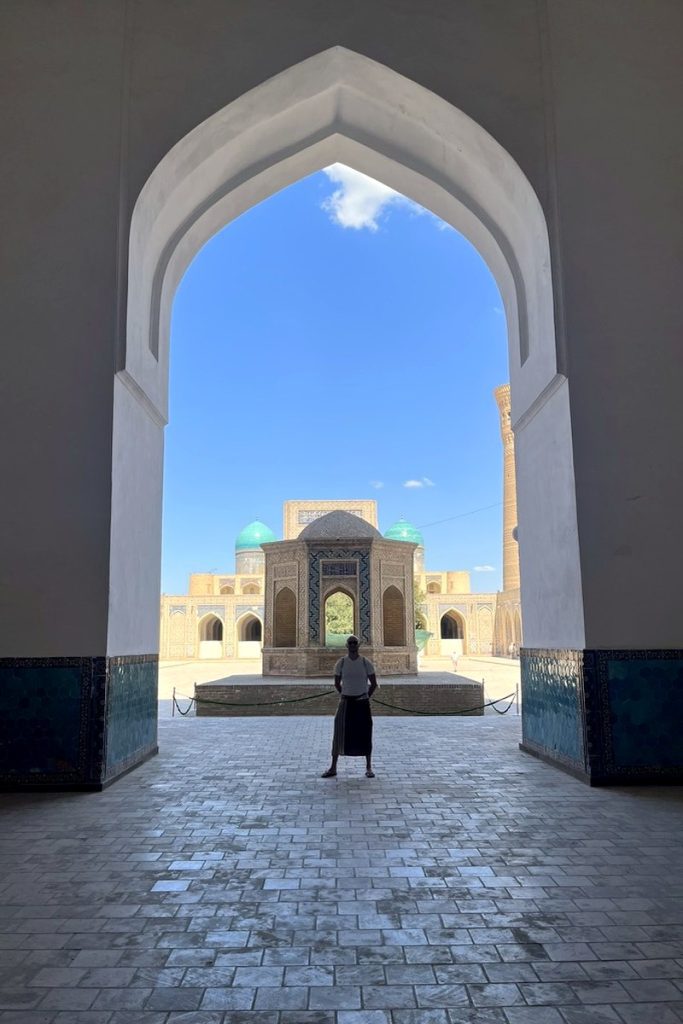
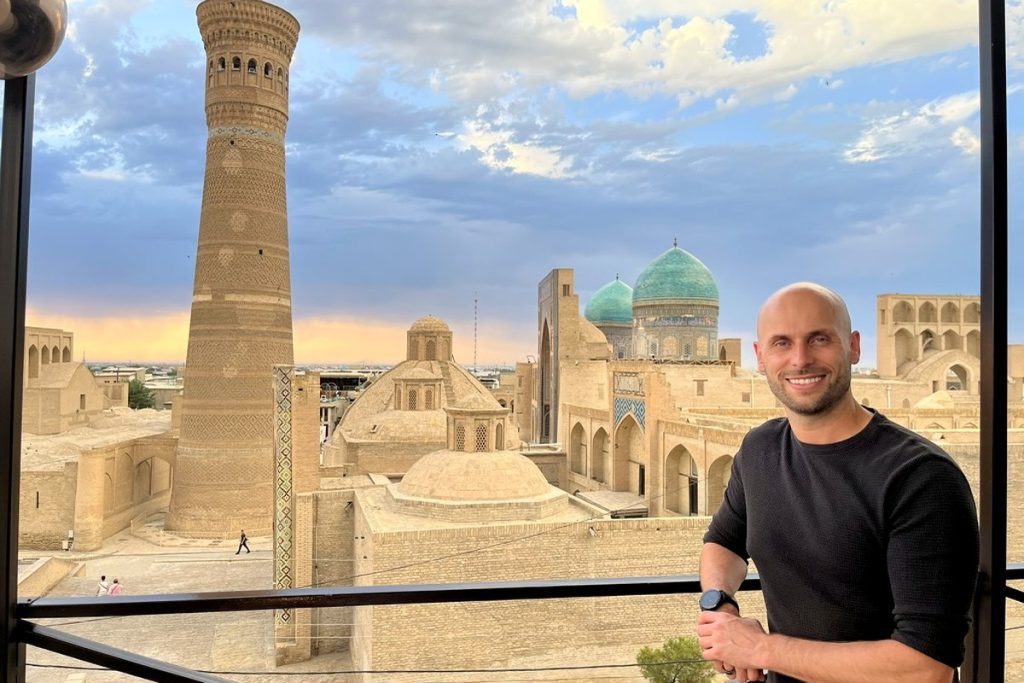
Make sure you book a table at Chashmai Mirob Cafe for the ultimate sunset spot of Kalyan Minaret, arriving 45 minutes-1 hour before sunset.
10. Give Crispy Eggplant Salad (Baqlajon) a Chance
So, following up on a good restaurant tip, I need to share a culinary gem in Uzbekistan and also its neighbours. If you’re like me and passionate about food when travelling, then buckle up and listen carefully.
Food in the Stans is severely underrated.
I don’t eat meat, and I didn’t miss out at all with the delicious breads, flavours and spices in all of the Stans, but one dish that stood out to me was the crispy eggplant salad. (Aubergines for Brits).
I know, the name doesn’t sell it too well. I didn’t listen to my friend, Tina, as she did a Meg Ryan in When Harry Met Sally impression every time she bit into it. I wish I had asked for a bite earlier, but I will live to regret it forever because when I did, I had to order it every time I sat down to eat after that.
Garlic, balsamic vinegar, chilli sauce and whatnot with a perfectly crisp texture. Phenomenal. Don’t make my mistake of thinking the name didn’t tempt you enough; it is a gift from the Gods, and you will see it on menus as “Baqlajon salad.”
11. Get lost in Bukhara’s old town
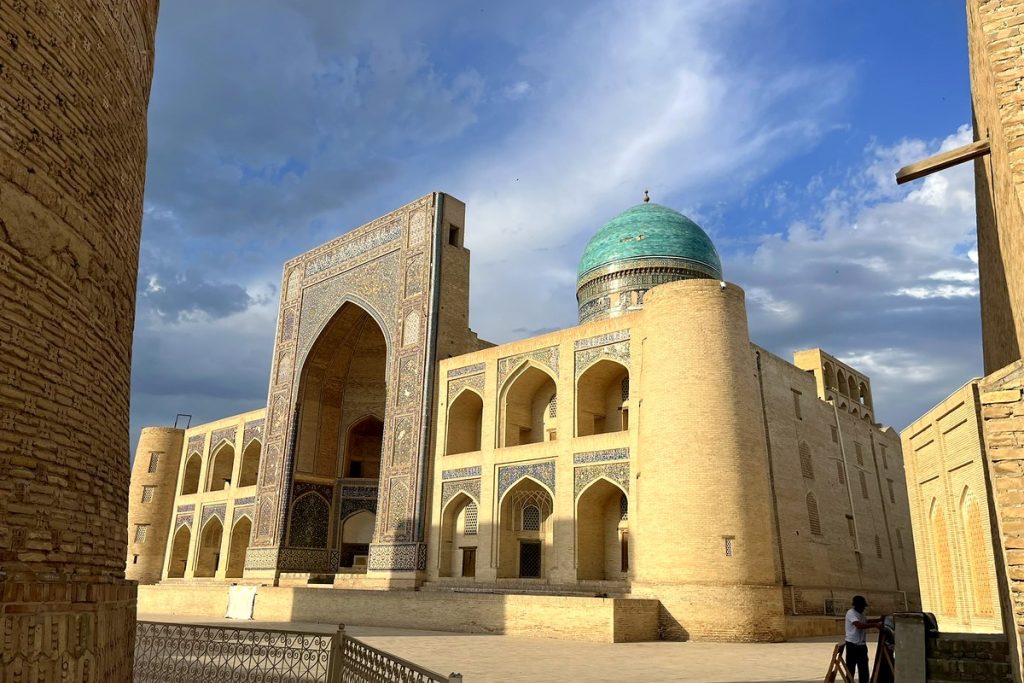
Bukhara was at the end of our Uzbekistan trip before moving on to Tajikistan. I was blue-and-white-building’d-out and just fancied a wander alone or with friends in the tour group, and Bukhara is ideal for that vibe.
A labyrinth of narrow alleyways, sandy-coloured buildings, and seductive little cafes makes up most of the centre. People watch father-and-son games of chess as they sit on a carpet on the floor, wash down a pot of Uzbek tea, and breathe in this open-air museum.